
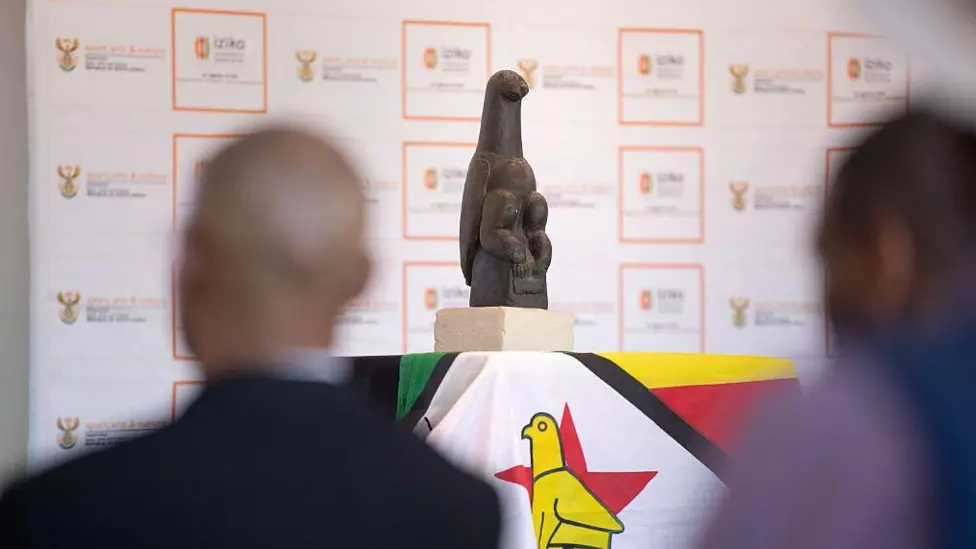
Zimbabwe’s most recognisable national symbol, the Zimbabwe Bird, has finally been fully repatriated after more than a century in exile, marking a significant moment in the country’s cultural and historical restoration.
This week, Emmerson Mnangagwa officially received the final soapstone bird sculpture, bringing to an end a 137-year journey that began during the colonial era. The artefact, taken in the late 19th century, had been held in South Africa after passing through the hands of British imperialist Cecil Rhodes.
The Zimbabwe Bird is more than a national emblem. It appears on the country’s flag, currency and coat of arms, symbolising identity, heritage and continuity. Its origins trace back to the ancient city of Great Zimbabwe, a medieval settlement built between the 11th and 15th centuries and recognised as one of Africa’s most important archaeological sites.
The stone sculptures, carved from soapstone, once stood on monoliths and walls overlooking Great Zimbabwe. Eight birds are known to exist, and for decades many were scattered across foreign collections following their removal by colonial explorers, hunters and missionaries.
The most recent return came from South Africa, which handed over the final bird alongside the remains of several individuals taken during the colonial period for scientific study. The repatriation highlights a broader reckoning with the legacy of colonial-era looting, where African artefacts and even human remains were removed under exploitative and often dehumanising circumstances.
Historically, the removal of the birds was tied to early colonial incursions into the region. In 1889, a European hunter took one of the sculptures from Great Zimbabwe and later sold it to Cecil Rhodes. Other pieces were subsequently transported to museums abroad, including in South Africa and Europe.
Following independence in 1980, Zimbabwe began a long campaign to recover the missing artefacts. Some were returned through diplomatic negotiations, including a notable exchange in 1981 when South Africa repatriated four birds. Germany later returned a pedestal fragment in 2003.
The final piece proved more difficult to retrieve due to legal restrictions tied to Rhodes’ estate. However, after years of negotiations, an agreement was reached to return the sculpture, with South Africa indicating intentions to make the repatriation permanent.
Beyond politics and diplomacy, the return carries deep cultural and spiritual meaning. The birds are believed by some scholars to represent sacred species such as the bateleur eagle, and they hold significance within Shona heritage. For many Zimbabweans, their absence represented a gap in the country’s historical narrative.
Now reunited, the sculptures will be housed near their original home at Great Zimbabwe, allowing citizens and visitors to engage directly with a symbol that had long been dispersed across borders.
The return also reflects a wider global movement, as former colonial powers and institutions face increasing pressure to return looted artefacts to their countries of origin. While many restitutions have come from European nations, this case stands out as a transfer between African states, highlighting regional cooperation in addressing historical injustices.
As Zimbabwe approaches another independence anniversary, the homecoming of its final stone bird closes a chapter shaped by displacement and recovery, restoring a key piece of the nation’s heritage to where it began.

Comments
Join the conversation. New comments appear after a quick review.
Loading comments…